Enhancing Education with AI-Driven Feedback and Actionable Insights
Node.js
Express.js
React.js
TypeScript
JavaScript
Sequelize
MySQL
Swagger
Redux
FastAPI
Python
GitHub
Git
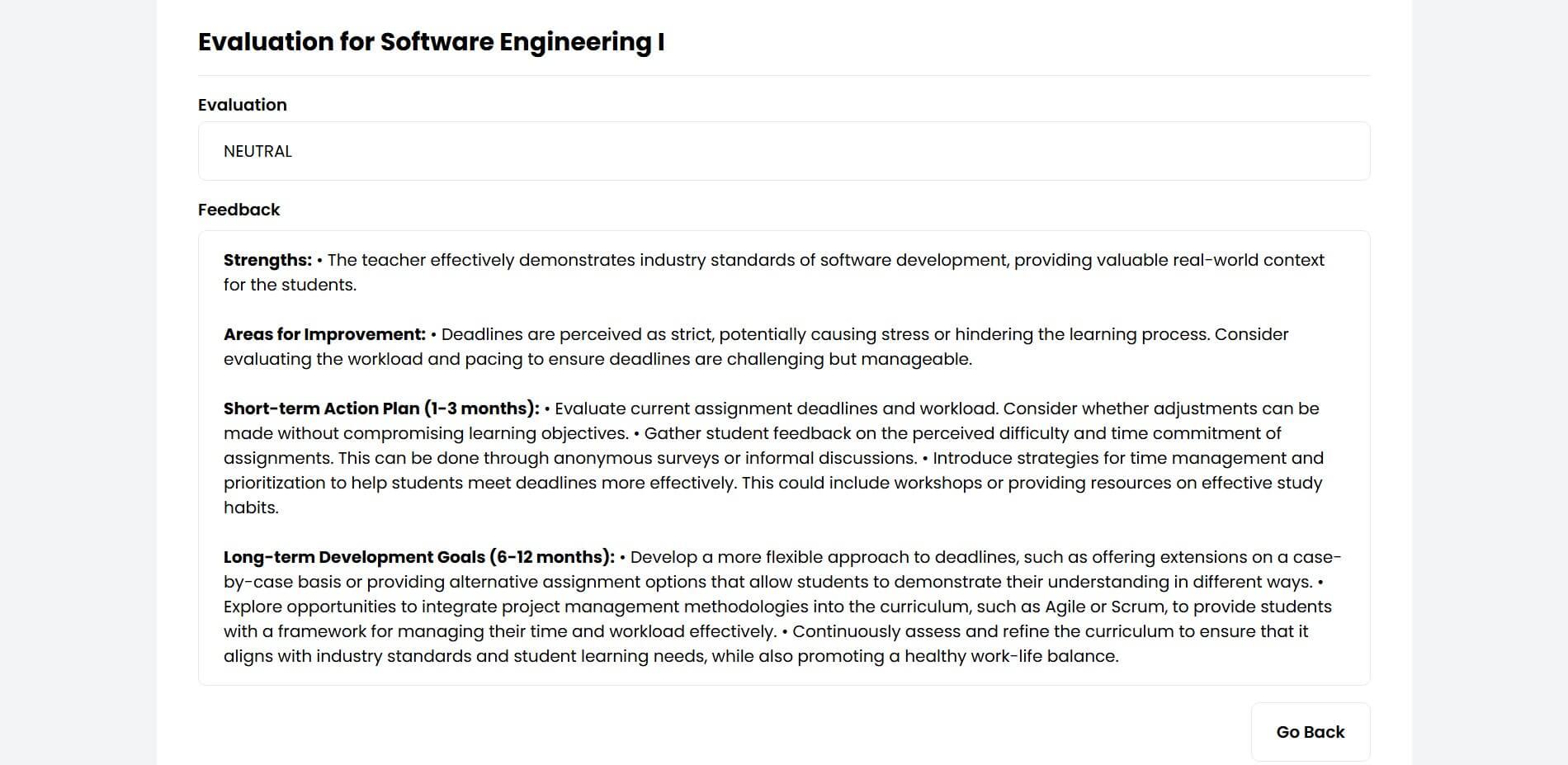
An AI-powered sentiment analysis system commissioned by a client to process anonymous student feedback, helping professors identify improvement areas with actionable suggestions. Includes an admin panel for evaluation cycles, professor management, and real-time insights.
Introduction
This project was commissioned by a client to modernize how universities gather and process student feedback. Traditional surveys often lacked depth and professors received delayed or unclear insights. By leveraging AI-driven sentiment analysis, we built a system that collects anonymous student feedback and automatically generates improvement suggestions. The platform included an admin panel for managing evaluations, a student-facing portal for submitting feedback, and a professor dashboard displaying AI-generated insights.
Objectives
The main objectives were to enable students to securely provide anonymous feedback, empower administrators with tools to manage evaluation cycles and professor profiles, and apply AI sentiment analysis to classify feedback as positive, neutral, or negative while generating actionable improvement plans. The project also aimed to build a responsive React.js frontend with secure API integration and ensure scalability and reliability using modern deployment pipelines.
Challenges
Key challenges included maintaining student anonymity while still linking responses to professors, designing a robust sentiment analysis pipeline capable of interpreting short and informal feedback, and managing scalable deployments across Netlify and Render. Database schema design using Sequelize and MySQL also required careful attention to relational integrity between students, professors, and feedback records.
Approach
To protect anonymity, student identifiers were separated from feedback content, ensuring data privacy while preserving the ability to link responses to professors. We integrated AI models with preprocessing pipelines to handle noisy and inconsistent student language. Sequelize migrations streamlined database versioning, while Swagger provided clear and interactive API documentation for seamless integration with the frontend. As the backend developer, I implemented API security, authentication, and deployment pipelines, directly coordinated with the client for requirements gathering, and incorporated change requests throughout the project.
Technology Used
The project went through two complete backend versions. The initial implementation was developed using Python (FastAPI), which effectively handled AI sentiment processing but resulted in heavier resource usage. To optimize performance and deployment efficiency, the backend was later reimplemented using Node.js and Express.js with Sequelize over MySQL. APIs were documented using Swagger. The frontend was developed with React.js and TypeScript, hosted on Netlify, while the backend was deployed on Render. Version control and collaboration were managed through GitHub and Git.
Skills Learned and Demonstrated
This project strengthened my backend development expertise with Node.js and Express.js, and ORM proficiency with Sequelize. I gained deeper experience in DevOps practices and CI/CD automation, learned to integrate AI sentiment analysis into real-world systems, and improved my skills in database schema design, API documentation, and API security. Direct coordination with the client and collaboration with the frontend developer further enhanced my ability to align backend services with both business requirements and frontend needs.
Conclusion
The AI-Based Sentiment Analysis Feedback System evolved through two backend implementations first with FastAPI and later with Node.js and Express.js. While the FastAPI version delivered accurate sentiment results using Python’s AI models, the Node.js version provided a lighter, more efficient runtime for deployment. The system transformed how student feedback is collected and utilized: students could safely share thoughts anonymously, professors gained actionable insights to improve teaching strategies, and administrators benefited from a streamlined evaluation process. Beyond technical achievements, this project demonstrated how AI integration, modern backend practices, and performance-driven decision-making can create impactful tools for education.
Gallery
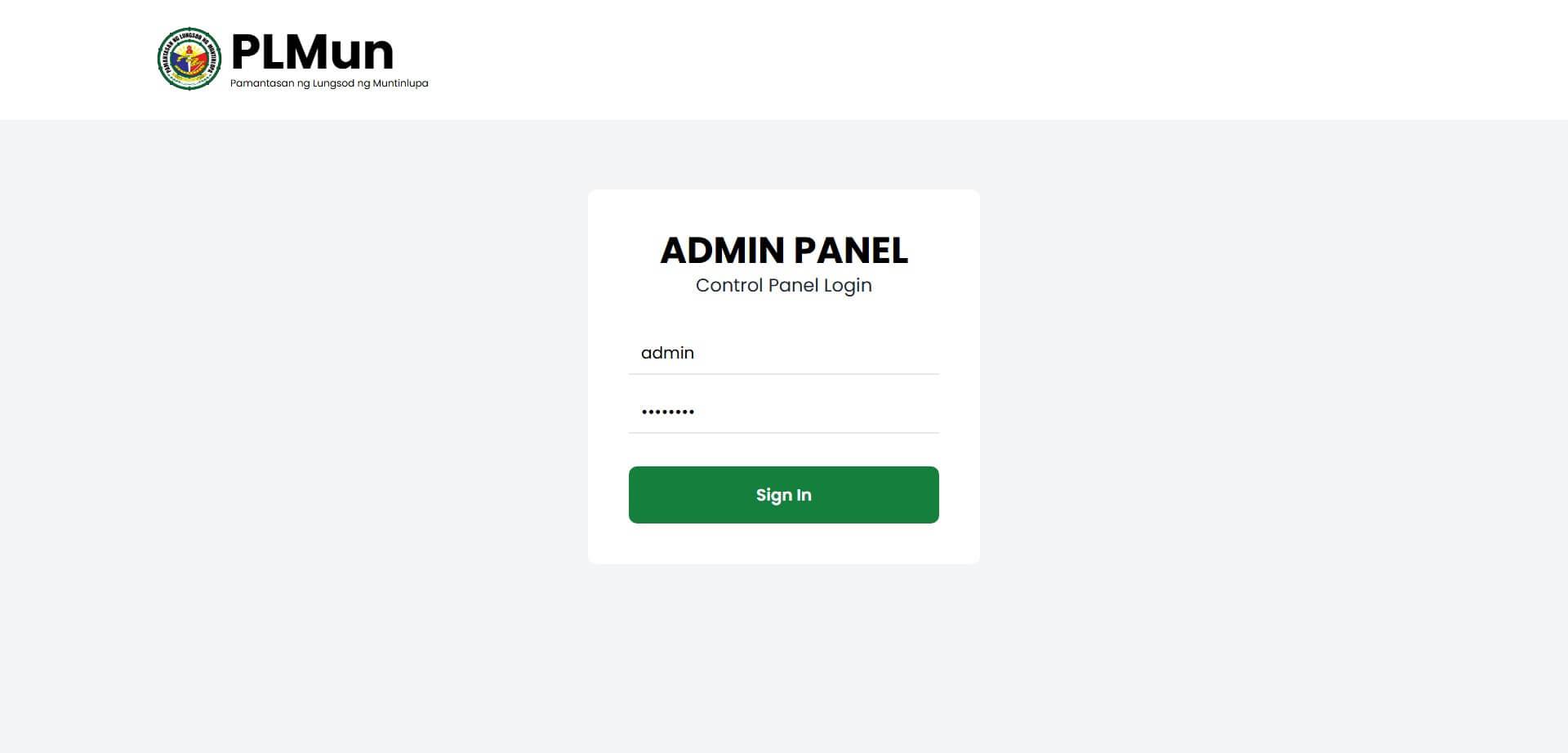
Secure login screen for administrators to access the feedback management system.
 Node.js
 Express.js
 React.js
 TypeScript
 JavaScript
 Sequelize
 MySQL
MySQL Swagger
 Redux
Redux FastAPI
 Python
 GitHub
 Git
Git